
As a supplier of Explosion-proof IR Laser Illuminators, I often encounter inquiries from customers regarding the light intensity of these devices at different distances. This topic is crucial for various applications, especially in environments where safety and reliable illumination are paramount. In this blog, I will delve into the factors affecting the light intensity of an explosion-proof IR laser illuminator and how it varies with distance.
Understanding the Basics of IR Laser Illumination
Before we discuss the light intensity at different distances, let's first understand the fundamentals of IR laser illumination. Infrared (IR) lasers emit light in the infrared spectrum, which is invisible to the human eye. This property makes them ideal for applications where covert surveillance or illumination is required, such as in industrial settings, security systems, and military operations.
An explosion-proof IR laser illuminator is specifically designed to operate safely in hazardous environments where there is a risk of explosion due to the presence of flammable gases, vapors, or dust. These illuminators are constructed with robust materials and comply with strict safety standards to prevent the ignition of explosive atmospheres.
Factors Affecting Light Intensity
The light intensity of an explosion-proof IR laser illuminator is influenced by several factors, including the power output of the laser, the beam divergence, and the absorption and scattering of light in the medium through which it propagates.
- Power Output: The power output of the laser is a primary determinant of the light intensity. Higher power lasers generally produce more intense illumination. However, it's important to note that the power output must be carefully regulated to ensure compliance with safety standards and to prevent damage to the device or the surrounding environment.
- Beam Divergence: The beam divergence refers to the spread of the laser beam as it travels away from the source. A smaller beam divergence results in a more concentrated beam and higher light intensity at a given distance. Conversely, a larger beam divergence leads to a more spread-out beam and lower light intensity.
- Absorption and Scattering: The absorption and scattering of light in the medium through which it propagates can also affect the light intensity. For example, in environments with high levels of dust or fog, the light may be absorbed or scattered, reducing the effective illumination range and intensity.
Light Intensity at Different Distances
The relationship between light intensity and distance follows the inverse square law, which states that the intensity of light is inversely proportional to the square of the distance from the source. Mathematically, this can be expressed as:
[I = \frac{P}{4\pi r^2}]
where (I) is the light intensity, (P) is the power output of the laser, and (r) is the distance from the source.
As the distance from the explosion-proof IR laser illuminator increases, the light intensity decreases rapidly. For example, if the distance is doubled, the light intensity will decrease by a factor of four. This means that the effective illumination range of the illuminator is limited, and it's important to choose a device with an appropriate power output and beam divergence for the specific application.
Practical Considerations
When selecting an explosion-proof IR laser illuminator, it's essential to consider the specific requirements of the application, including the desired illumination range, the environmental conditions, and the safety regulations. Here are some practical tips to help you make an informed decision:

- Determine the Illumination Range: Calculate the required illumination range based on the distance between the illuminator and the target area. Consider the inverse square law and choose a device with a power output and beam divergence that can provide sufficient illumination at the desired distance.
- Evaluate the Environmental Conditions: Take into account the environmental conditions, such as the presence of dust, fog, or other obstacles, that may affect the light intensity. In harsh environments, you may need to choose a device with a higher power output or a more focused beam to compensate for the absorption and scattering of light.
- Comply with Safety Regulations: Ensure that the explosion-proof IR laser illuminator complies with all relevant safety regulations and standards. This includes certifications such as ATEX, IECEx, and UL, which indicate that the device has been tested and approved for use in hazardous environments.
VCSEL IR Laser Diode Technology
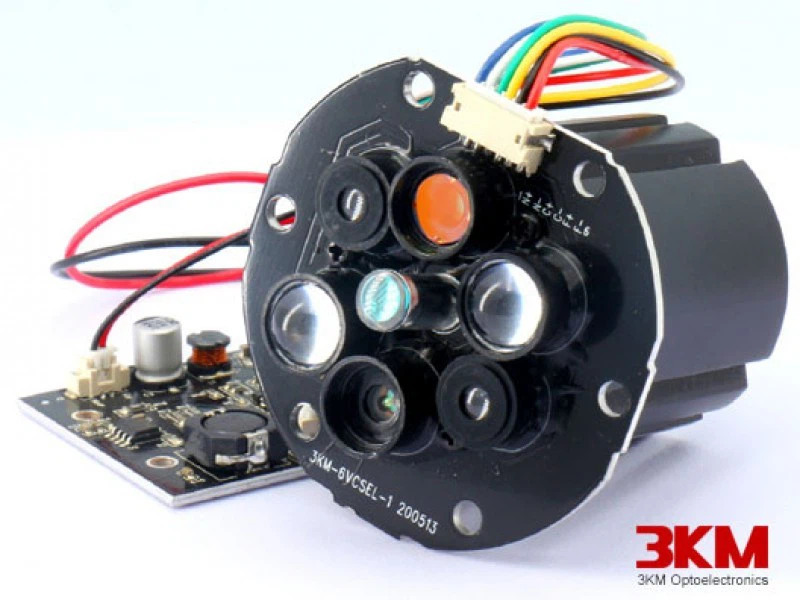
One of the key technologies used in explosion-proof IR laser illuminators is the Vertical-Cavity Surface-Emitting Laser (VCSEL) IR laser diode. VCSEL IR Laser Diode offers several advantages over traditional edge-emitting lasers, including lower power consumption, higher efficiency, and better beam quality.
VCSELs emit light perpendicular to the surface of the chip, resulting in a circular beam with a low divergence angle. This makes them ideal for applications where a focused and uniform illumination is required. Additionally, VCSELs are more reliable and have a longer lifespan compared to edge-emitting lasers, making them a cost-effective solution for long-term use.
Conclusion
In conclusion, the light intensity of an explosion-proof IR laser illuminator at different distances is influenced by several factors, including the power output, beam divergence, and absorption and scattering of light. Understanding these factors is essential for selecting the right device for your specific application and ensuring optimal performance and safety.
As a supplier of Explosion-proof IR Laser Illuminator, we offer a wide range of products that are designed to meet the diverse needs of our customers. Our explosion-proof IR laser illuminators are built with the latest technology and comply with all relevant safety regulations, ensuring reliable and efficient operation in hazardous environments.
If you have any questions or need further information about our explosion-proof IR laser illuminators, please don't hesitate to contact us. We are committed to providing our customers with the highest quality products and services, and we look forward to working with you to meet your illumination needs.
References
- Hecht, Jeff. Understanding Lasers: An Entry-Level Guide. Wiley, 2012.
- Saleh, Bahaa E. A., and Malvin Carl Teich. Fundamentals of Photonics. Wiley, 2007.