
As a supplier of Long Range Laser Beacons, I'm often asked about how these remarkable devices work. In this blog, I'll delve into the science and technology behind Long Range Laser Beacons, explaining their functionality, applications, and advantages.
The Basics of Laser Technology
Before we explore the workings of Long Range Laser Beacons, it's essential to understand the fundamentals of laser technology. A laser, which stands for "Light Amplification by Stimulated Emission of Radiation," is a device that emits a highly focused and coherent beam of light. Unlike ordinary light sources, such as incandescent bulbs or fluorescent lamps, lasers produce light that is monochromatic (single - color), collimated (parallel rays), and coherent (waves in phase).
The process of generating a laser beam begins with a gain medium, which can be a solid, liquid, or gas. In the case of many Long Range Laser Beacons, solid - state gain media like neodymium - doped yttrium aluminum garnet (Nd:YAG) or semiconductor materials are commonly used. When energy is supplied to the gain medium, usually through optical pumping (using a flashlamp or another laser) or electrical current injection (in semiconductor lasers), the atoms or molecules in the gain medium are excited to higher energy levels.
As these excited particles return to their lower energy states, they emit photons. Through a process called stimulated emission, these photons stimulate other excited particles to emit additional photons of the same wavelength, phase, and direction. This results in a chain reaction that amplifies the light, creating a powerful and concentrated laser beam.
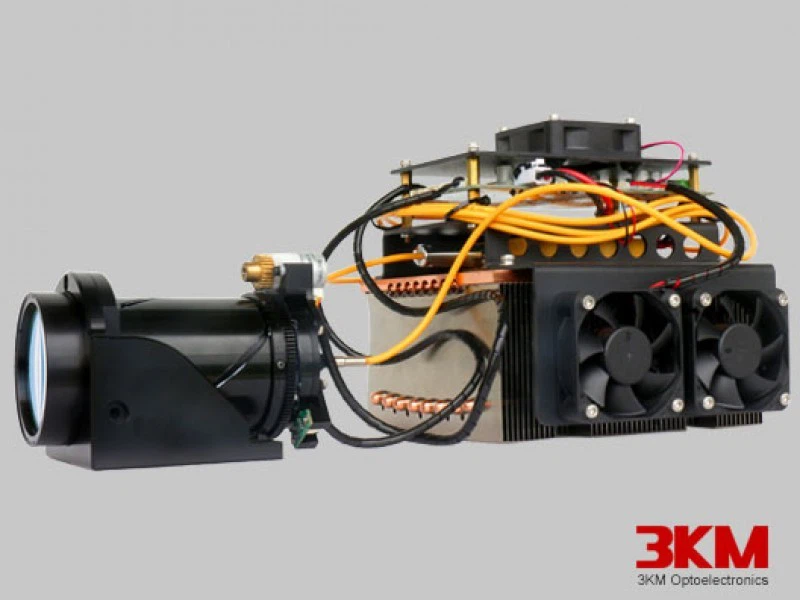

Components of a Long Range Laser Beacon
A Long Range Laser Beacon consists of several key components, each playing a crucial role in its operation:
- Laser Source: This is the heart of the beacon, responsible for generating the laser beam. As mentioned earlier, different types of laser sources can be used, depending on the specific requirements of the application. For long - range applications, high - power lasers are typically employed to ensure that the beam can travel significant distances without significant attenuation.
- Optics: The optics system is used to shape, focus, and direct the laser beam. Lenses and mirrors are carefully designed and arranged to collimate the beam, reducing its divergence and increasing its intensity over long distances. Additionally, the optics may include beam expanders to increase the diameter of the beam, which can improve its visibility and reduce the risk of eye damage at close range.
- Power Supply: A reliable power supply is essential to provide the energy needed to operate the laser source. Depending on the type of laser and the application, the power supply can be a battery, a solar panel, or a connection to the electrical grid. In some cases, a combination of power sources may be used to ensure continuous operation, especially in remote or off - grid locations.
- Control System: The control system manages the operation of the laser beacon, including turning the laser on and off, adjusting its power output, and controlling the beam's direction and modulation. This system can be programmed to operate in different modes, such as continuous wave (CW) or pulsed mode, depending on the specific requirements of the application.
How Long Range Laser Beacons Work in Practice
Once the laser beam is generated and shaped by the optics, it is emitted into the atmosphere. The beam's ability to travel long distances depends on several factors, including the power of the laser, the wavelength of the light, and the atmospheric conditions.
In clear and dry air, laser beams can travel relatively long distances with minimal attenuation. However, factors such as fog, haze, rain, or dust can scatter and absorb the laser light, reducing its range and visibility. To mitigate these effects, some Long Range Laser Beacons are designed to operate at specific wavelengths that are less affected by atmospheric conditions. For example, green lasers are often used because they are more visible to the human eye and are less scattered by water droplets in the air compared to other wavelengths.
When the laser beam reaches its destination, it can be detected by a receiver or simply observed as a visible signal. In some applications, the laser beacon may be used for line - of - sight communication, where the beam is modulated to transmit data. By varying the intensity or the pulse pattern of the laser beam, information can be encoded and transmitted over long distances.
Applications of Long Range Laser Beacons
Long Range Laser Beacons have a wide range of applications across various industries:
- Navigation and Surveying: In aviation and maritime industries, laser beacons can be used as navigation aids, providing a visible reference point for pilots and sailors. They can also be used in land surveying to establish precise lines of sight and measure distances.
- Security and Surveillance: Laser beacons can be used to create virtual fences or perimeters, alerting security personnel when the beam is interrupted. They can also be used for long - range surveillance, providing a covert way to monitor large areas.
- Wildlife Management: All - Weather Green Laser Bird Repellent is an example of how laser beacons are used in wildlife management. Birds perceive laser beams as a physical threat, and the movement of the beam can deter them from landing or roosting in certain areas, such as airports, agricultural fields, or industrial sites.
- Desert and Remote Area Applications: The Desert - Spec Solar Laser Beacon System is specifically designed for use in desert and remote areas. These beacons can be powered by solar energy, making them ideal for applications where access to the electrical grid is limited. They can be used for navigation, communication, and environmental monitoring in these harsh environments.
Advantages of Long Range Laser Beacons
There are several advantages to using Long Range Laser Beacons compared to traditional lighting or signaling devices:
- Long Range and High Visibility: Laser beams can travel much longer distances than ordinary light sources, making them ideal for applications where long - range signaling or communication is required. Their high intensity and focused nature also make them highly visible, even in low - light or adverse weather conditions.
- Directional and Precise: Laser beams can be precisely directed, allowing for targeted signaling or communication. This is particularly useful in applications where specific areas need to be illuminated or where data needs to be transmitted between two specific points.
- Energy Efficiency: Compared to traditional lighting systems, lasers are generally more energy - efficient, especially when used in pulsed mode. This can result in significant cost savings, particularly in applications where continuous operation is required.
- Low Maintenance: Long Range Laser Beacons typically have fewer moving parts and require less maintenance than traditional lighting or signaling devices. This makes them more reliable and cost - effective in the long run.
Contact for Purchase and Consultation
If you're interested in learning more about our Long Range Laser Beacons or are considering a purchase, we'd be more than happy to assist you. Our team of experts can provide you with detailed information about our products, their features, and how they can be customized to meet your specific needs. Whether you're in the aviation, security, wildlife management, or any other industry, we have the solutions to help you achieve your goals.
References
- Hecht, Jeff. "Understanding Lasers: An Entry - Level Guide." O'Reilly Media, 2012.
- Saleh, Bahaa E. A., and Malvin Carl Teich. "Fundamentals of Photonics." John Wiley & Sons, 2007.
- Vallance, John. "Laser Safety: A Guide for Users." Taylor & Francis, 2005.