
As a supplier of 5km long range white light illumination, I've encountered numerous inquiries about the heat dissipation methods for such high - performance lighting systems. In this blog, I'll delve into the heat dissipation methods of 5km long range white light illumination, exploring the principles, challenges, and solutions.
The Significance of Heat Dissipation in 5km Long Range White Light Illumination
5km long range white light illumination systems are designed to provide intense, far - reaching light. These systems often use high - power light sources, such as high - intensity LEDs or lasers. When these light sources operate, a significant amount of electrical energy is converted into heat. Excessive heat can have several detrimental effects on the performance and lifespan of the illumination system.
Firstly, high temperatures can reduce the luminous efficiency of the light source. As the temperature rises, the internal resistance of the light - emitting components increases, which leads to a decrease in the conversion efficiency of electrical energy to light energy. This means that more power is wasted as heat, and the overall brightness of the illumination system decreases.
Secondly, heat can cause thermal stress on the components of the illumination system. Different materials in the system have different coefficients of thermal expansion. When the temperature changes, these materials expand or contract at different rates, which can lead to mechanical stress and even damage to the components. Over time, this can cause the system to malfunction or fail prematurely.
Therefore, effective heat dissipation is crucial for maintaining the performance and reliability of 5km long range white light illumination systems.
Common Heat Dissipation Methods
1. Heat Sinks
Heat sinks are one of the most commonly used heat dissipation methods in lighting systems. A heat sink is a passive cooling device that consists of a large surface area of metal, usually aluminum or copper. The heat sink is attached to the light source, and heat is transferred from the light source to the heat sink through conduction.
The large surface area of the heat sink allows for efficient heat transfer to the surrounding air through convection. The fins on the heat sink increase the surface area even further, enhancing the convective heat transfer. For 5km long range white light illumination systems, heat sinks can be designed with complex fin structures to maximize the heat dissipation efficiency.
However, the effectiveness of heat sinks is limited by the ambient temperature and the air flow around the heat sink. In high - temperature environments or areas with poor air circulation, the heat dissipation performance of heat sinks may be reduced.
2. Fans
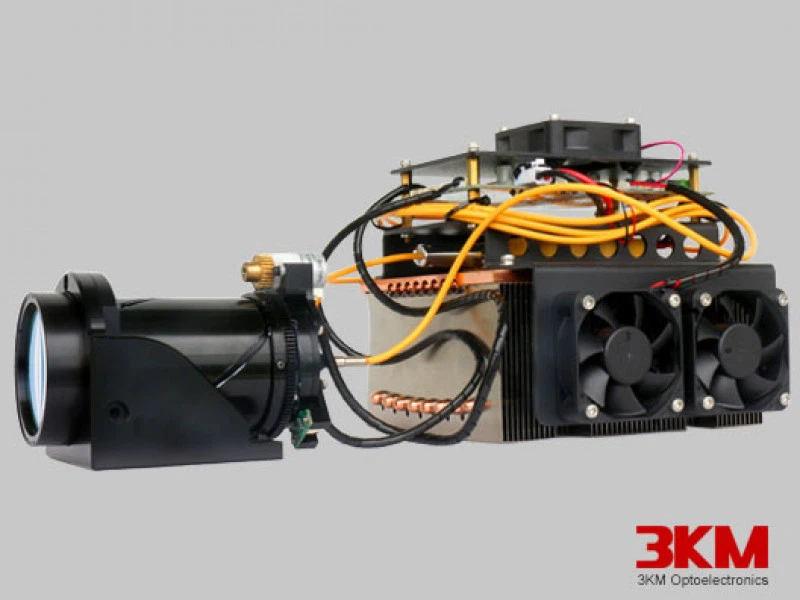
Fans are often used in conjunction with heat sinks to enhance the heat dissipation performance. A fan can increase the air flow around the heat sink, which significantly improves the convective heat transfer. By forcing air over the fins of the heat sink, the fan can carry away the heat more quickly.
There are different types of fans that can be used in 5km long range white light illumination systems, such as axial fans and centrifugal fans. Axial fans are suitable for applications where a large volume of air needs to be moved at a relatively low pressure, while centrifugal fans can generate higher pressures and are more suitable for applications with restricted air flow paths.
One of the challenges of using fans is the noise they generate. In some applications, such as surveillance systems in quiet environments, the noise from the fans may be a problem. Additionally, fans have moving parts, which means they are more prone to mechanical failure compared to passive heat dissipation methods.
3. Liquid Cooling
Liquid cooling is a more advanced heat dissipation method that can provide higher heat dissipation efficiency compared to air - cooling methods. In a liquid cooling system, a coolant, such as water or a special coolant fluid, is circulated through a heat exchanger attached to the light source.
The heat from the light source is transferred to the coolant through conduction, and the heated coolant is then pumped to a radiator, where the heat is dissipated to the surrounding air. Liquid cooling systems can be more effective in removing heat from high - power light sources because liquids have a higher specific heat capacity than air, which means they can absorb more heat per unit volume.

However, liquid cooling systems are more complex and expensive to implement compared to air - cooling methods. They also require additional components, such as pumps and radiators, and there is a risk of coolant leakage, which can damage the illumination system.
Heat Dissipation in White Laser Lighting Modules
As a supplier, we also offer White Laser Lighting Module and RGB White Laser Lighting Module. Laser - based lighting modules have unique heat dissipation requirements.
Lasers generate heat mainly from the laser diodes. The heat generated in laser diodes can be extremely high, and it needs to be dissipated quickly to maintain the performance and lifespan of the diodes. In white laser lighting modules, heat sinks are often used in combination with active cooling methods.
For example, a heat sink can be directly attached to the laser diode to conduct the heat away. Then, a fan or a liquid cooling system can be used to enhance the heat dissipation from the heat sink. In some high - end white laser lighting modules, a closed - loop liquid cooling system may be used to ensure precise temperature control of the laser diodes.
Challenges in Heat Dissipation for 5km Long Range White Light Illumination
Designing an effective heat dissipation system for 5km long range white light illumination systems is not without challenges.
One of the main challenges is the size and weight constraints. These illumination systems are often required to be compact and lightweight, especially for applications such as airborne or mobile surveillance. This limits the size of the heat dissipation components that can be used. For example, large heat sinks or bulky liquid cooling systems may not be feasible due to space and weight limitations.
Another challenge is the harsh operating environments. 5km long range white light illumination systems may be used in extreme temperatures, high humidity, or dusty environments. These environmental factors can affect the performance of the heat dissipation system. For example, in high - humidity environments, moisture can accumulate on the heat sink or in the cooling system, which can lead to corrosion and reduced heat dissipation efficiency.
Solutions to Heat Dissipation Challenges
To overcome the size and weight constraints, advanced materials and compact heat dissipation designs are being developed. For example, using high - thermal - conductivity materials, such as graphite or carbon nanotubes, can increase the heat transfer efficiency without significantly increasing the size and weight of the heat sink.
In terms of dealing with harsh operating environments, protective enclosures can be used to shield the heat dissipation system from dust, moisture, and extreme temperatures. These enclosures can be designed with ventilation holes or air filters to ensure proper air flow while protecting the components inside.
Conclusion
In conclusion, heat dissipation is a critical aspect of 5km long range white light illumination systems. Effective heat dissipation methods, such as heat sinks, fans, and liquid cooling, are essential for maintaining the performance and reliability of these systems. However, there are challenges in designing heat dissipation systems, including size and weight constraints and harsh operating environments.
As a supplier of 5km long range white light illumination, we are constantly researching and developing new heat dissipation technologies to meet the needs of our customers. If you are interested in our products and want to discuss the heat dissipation requirements for your specific application, or if you have any other questions regarding our 5km long range white light illumination systems, please feel free to contact us for a procurement negotiation. We are committed to providing you with the best - in - class lighting solutions with efficient heat dissipation.
References
- Incropera, F. P., & DeWitt, D. P. (2002). Fundamentals of Heat and Mass Transfer. John Wiley & Sons.
- Howell, J. R., Menguc, M. P., & Siegel, R. (2010). Thermal Radiation Heat Transfer. CRC Press.